New Orleans Chiller Maintenance: Commercial Guide by New Orleans Mechanical Pros
Commercial chiller maintenance in New Orleans is not optional - it is a direct response to operating cooling equipment in one of the most demanding climates in the country. This guide from New Orleans Mechanical Pros covers everything facility managers and building owners need to know about maintain
Commercial chiller maintenance in New Orleans is not optional - it is a direct response to operating cooling equipment in one of the most demanding climates in the country. This guide from New Orleans Mechanical Pros covers everything facility managers and building owners need to know about maintaining air-cooled chillers, water-cooled chillers, industrial chillers, and absorption chillers in the Greater New Orleans area.
Key Takeaways
Commercial HVAC maintenance in New Orleans includes inspection, cleaning, testing, adjustments, and monitoring of compressors, condensers, evaporators, pumps, controls, and condenser water loops. New Orleans Mechanical Pros supports commercial HVAC and chilled-water systems across the Orleans area and Gulf South.
Maintenance tasks cover the entire cooling system: refrigerant circuits, chilled water and condenser water loops, heat exchangers, electrical connections, sensors, and building automation integration.
New Orleans conditions - high humidity, a cooling season that can stretch 10 to 12 months, and coastal corrosion from salt-laden air - make preventive maintenance essential to avoid chiller downtime and rising energy consumption.
Both air-cooled and water-cooled chillers, including industrial chillers and absorption chillers, need tailored scheduled maintenance intervals based on equipment type, age, and operating conditions.
Readers can schedule commercial chiller maintenance or request chiller repair services in New Orleans, Louisiana directly with New Orleans Mechanical Pros.
What Is Commercial Chiller Maintenance in New Orleans?
Commercial chiller maintenance is the planned inspection, cleaning, testing, adjustment, and monitoring of chiller machine maintenance components to sustain cooling capacity, energy efficiency, reliability, and equipment life. In New Orleans, Louisiana, New Orleans Mechanical Pros provides these services for commercial and industrial facilities operating chilled-water systems year-round.
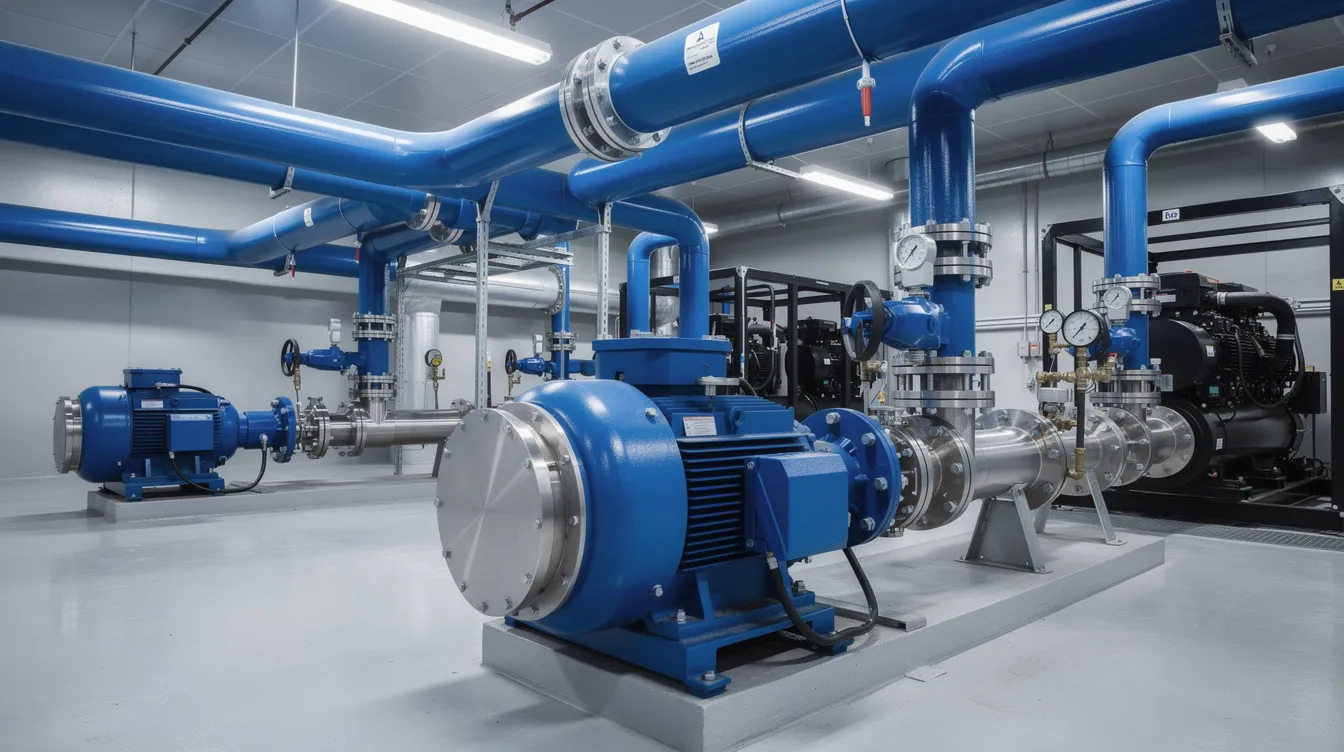
A commercial chiller removes unwanted heat from chilled water, which then circulates through air handlers, fan coils, or process cooling loads to condition a building or support many industrial processes. The chiller's cooling effect depends on the coordinated performance of several components:
Compressor unit - drives the refrigeration cycle
Evaporator - transfers heat from chilled water into the refrigerant
Condenser - rejects absorbed heat to outdoor air or condenser water
Expansion valve - regulates refrigerant flow between high and low pressure sides
Pumps and piping - move chilled water and condenser water through the system
Maintenance tasks address each of these components along with controls, sensors, electrical systems, and water treatment. The goal is to keep the entire cooling system operating at or near its design conditions, which directly affects occupant comfort, process reliability, and monthly energy bills.
Why Chiller Maintenance Matters More in New Orleans' Climate
New Orleans has a subtropical climate characterized by high humidity and intense heat. The city averages 75% relative humidity year-round, and New Orleans summers average around 77 days with temperatures above 90°F. Outdoor temperatures can reach 95°F with 80% humidity, creating sustained, heavy cooling loads that stress every component in a commercial HVAC system.
This humid climate increases both sensible and latent loads on chillers. Compressors work harder, condenser water warms faster, and heat transfer surfaces accumulate fouling more rapidly than in drier regions. High humidity promotes algae and bacterial growth in chillers, cooling towers, and condenser water loops. Without proper water treatment, biological growth and scale coat tube surfaces, reducing heat transfer efficiency and pushing energy consumption higher.
Chillers in New Orleans face increased corrosion from salt-laden air, especially at facilities near Lake Pontchartrain or the Mississippi River. Salt aerosols can accelerate corrosion in chiller systems near coastal areas, attacking aluminum condenser coils on air-cooled units and degrading exposed electrical components. High ambient temperatures also contribute to rapid oxidation of electrical connections and control panel components.
High humidity levels make Legionella management a compliance necessity in New Orleans. The city's mechanical code requires water management plans per ASHRAE Standard 188 for buildings with open-circuit cooling towers and water-cooled chillers, including biocide monitoring, bacteriological testing, and documented remediation procedures.
When maintenance is neglected, the consequences compound: rising kW/ton, nuisance high-pressure trips during August heat waves, premature compressor wear, and shortened equipment life. Severe weather and high humidity require a proactive maintenance approach for chillers operating in this environment.
Preventive Chiller Maintenance vs. Reactive Chiller Repair
Preventive maintenance is planned, scheduled work - inspecting, cleaning, and testing chiller components before problems cause failures. Reactive repair happens after something breaks. New Orleans Mechanical Pros structures its preventive maintenance programs to keep commercial chillers ahead of the conditions that cause breakdowns, rather than responding after cooling is already lost.
The relationship is straightforward:
Maintenance → Early Detection → Improved Reliability → Reduced Downtime → Better Efficiency → Longer Equipment Life
Quarterly inspections in New Orleans allow technicians to catch fouled condenser tubes, degraded compressor oil, failing pump seals, or drifting sensors before these conditions escalate. Two scenarios illustrate why this matters:
A downtown hotel loses its primary chiller during Mardi Gras weekend. Emergency repairs during peak season mean premium labor costs, potential guest displacement, and revenue loss that dwarfs the cost of a quarterly service call.
A hospital's chiller trips on high pressure during a late-July heat wave. Operating rooms, imaging labs, and patient floors lose climate control. Redundancy helps, but the failed unit still requires expensive, urgent repair under the worst possible conditions.
A situation moves from "maintenance" to "repair" when components have already failed - a compressor seizure, a major refrigerant leak, a burned motor winding, or repeated high-pressure trips that resist adjustment. At that point, corrective work is unavoidable.
Can Regular Chiller Maintenance Prevent Breakdowns?
Routine preventive maintenance can significantly reduce, but not completely eliminate, unplanned chiller breakdowns. No maintenance program can prevent every failure, but a well-executed program catches the majority of developing problems before they shut down a system.
Daily logs of operating conditions help predict future chiller issues. Trending temperatures, pressures, flow rates, and kW draw over weeks and months reveals gradual drift - a slowly rising condenser approach temperature, a creeping increase in compressor amps, or a declining chilled-water temperature differential. These patterns signal problems while there is still time to act.
Specific failure modes that maintenance can often prevent or mitigate include:
Fouled condenser or evaporator tubes reducing heat transfer
Low refrigerant charge causing capacity loss and compressor stress
Failing condenser water pumps or stuck valves restricting flow
Overheating motors from poor lubrication, loose connections, or blocked ventilation
Honest limitations apply. Lightning strikes, sudden bearing failures, or controller defects can still cause unexpected downtime despite proper maintenance. New Orleans Mechanical Pros uses on-site diagnostics and, where available, remote monitoring data from building automation systems to anticipate problems and reduce response time when unplanned events occur.
New Orleans Mechanical Pros Commercial Chiller Maintenance Checklist
This section provides the core preventive maintenance checklist used by New Orleans Mechanical Pros for commercial and industrial chiller systems. It covers both air-cooled and water-cooled chillers used in New Orleans commercial buildings, hotels, hospitals, data centers, and industrial facilities.
Major inspection areas include:
Operating conditions and performance trending
Compressor and compressor oil
Refrigerant charge and system performance
Condenser components (air-side or water-side)
Evaporator and chilled-water side
Pumps, valves, and water flow
Electrical components and controls
Sensors, safety devices, and alarm history
Technicians document readings - pressures, temperatures, amps, flow rates - from every service visit. This data supports trend analysis and capital planning. The checklist complements, but does not replace, manufacturer-specific maintenance procedures and site safety requirements.
Inspect Chiller Operating Conditions
Every maintenance visit begins with recording the chiller's current operating snapshot. Chilled water temperature and condenser temperature should be regularly monitored, along with:
Entering and leaving chilled-water temperatures and temperature differential (ΔT)
Refrigerant suction and discharge pressures
Entering and leaving condenser-water temperatures (water-cooled) or ambient air temperature (air-cooled)
Flow indicators or differential pressures confirming proper water flow
Current load percentage and operating setpoints
Last 30 days of alarm history from the chiller controller
Trending these values across seasons - April start-up, August peak load, October shoulder season - reveals performance degradation early, before it triggers alarms or causes failures.
Inspect the Chiller Compressor and Compressor Oil
New Orleans commercial buildings commonly use centrifugal, screw compressors, and scroll compressors. Each type has specific inspection points:
Operating temperatures at suction and discharge
Oil levels and oil color (dark or milky oil indicates contamination)
Signs of foaming in oil sight glass
Vibration levels and unusual noises on start-up and under load
Electrical readings: running amps compared to nameplate, insulation resistance
For large centrifugal units, annual compressor oil analysis detects metal particles, moisture, or acid formation - early indicators of internal wear. Magnetic bearing chillers do not use compressor oil, so maintenance focuses on control software, sensor calibration, and power electronics.
Check Refrigerant Charge and System Performance
Proper refrigerant charge is crucial for optimal chiller performance. An incorrect charge - whether too low or too high - directly reduces cooling capacity and increases energy consumption. Refrigerant leaks decrease chiller efficiency and reliability and, if unaddressed, can cause compressor burnout.
Technicians evaluate charge using superheat and subcooling measurements and sight glass observations rather than relying on generic pressure readings alone. In the humid climate of New Orleans, non-condensables (air and moisture) can enter systems during maintenance or through small leaks, raising head pressure and energy use.
Refrigerant management includes monitoring for leaks and moisture.Monitor refrigerant levels to ensure optimal chiller performance. Maintaining refrigerant levels prevents compressor burnout. New Orleans Mechanical Pros technicians follow EPA-compliant procedures for refrigerant handling, leak detection, recovery, and documentation. Repeated topping off without locating and repairing the leak source is not acceptable - it increases long-term operating costs and environmental impact.
Inspect and Clean Condenser Components
Condenser maintenance differs by system type:
Air-cooled condensers:
Clean condenser coils before and after peak pollen and storm seasons
Inspect fan motors, blades, and belts for wear
Verify adequate airflow; remove obstructions
Airborne pollutants can create an insulating layer on condenser coils, reducing capacity
Water-cooled condensers:
Condenser tubes should be cleaned at least annually - annual cleaning of condenser tubes is essential for efficiency
Routine mechanical tube brushing prevents fouling and maintains heat transfer efficiency
Inspect tube sheets for pitting or erosion
Monitor condenser approach temperature; a rising condenser approach temperature can indicate tube fouling or biological growth
Maintain condenser water flow velocity between 3 and 11 FPS to minimize both fouling and erosion
For water-cooled systems, verify cooling tower operation, clean basin and strainers, and inspect drift eliminators. Scale, corrosion, and biological growth in condenser water loops are constant risks in the Gulf South's warm, humid environment.
Inspect the Evaporator and Chilled-Water Side
Evaporator inspection focuses on chilled-water flow, tube cleanliness, and freeze protection:
Check entering and leaving chilled-water temperatures and verify ΔT matches design conditions
Confirm flow matches design requirements - chillers need 2.5 to 3 GPM per ton for efficiency
Inspect for fouling, sludge, or corrosion products that reduce heat transfer
Regular inspections and cleaning of cooling coils can improve indoor air quality by reducing contaminants circulating through the air handling system
For facilities using glycol mixtures (common in 24/7 data centers), test concentration annually for proper freeze protection
Verify low-temperature cutout settings to prevent evaporator freezing during low-load or mild-weather operation
Check Pumps, Valves, and Water Flow
Chilled-water pumps and condenser-water pumps are essential to proper operation of the entire cooling system. Inspection tasks include:
Verify pump rotation direction and running amperage
Listen for bearing noise; inspect mechanical seals and couplings
Check differential pressure across pumps and strainers to identify blockages or closed valves
Confirm functional flow switches and interlocks that protect the chiller from low-flow conditions
Verify proper balancing of multiple pumps and loops in large commercial buildings
Chillers need 2.5 to 3 gallons per minute per ton for efficiency. Restricted flow through dirty strainers, stuck valves, or air-bound pipes degrades performance and can trigger protective shutdowns.
Inspect Electrical Components and Controls
New Orleans Mechanical Pros electricians and technicians check the following during each visit:
Tighten and thermally scan power connections for hot spots
Inspect contactors, relays, and motor starters
Check variable frequency drives for fault codes and cooling fan operation
Verify overload settings, breaker sizes, and condition of disconnect switches
Clean control panel interiors; confirm proper ventilation and check for moisture intrusion after storms
Review trend logs and building automation system (BAS) points for abnormal cycling or staging behavior
High ambient temperatures and humidity accelerate wear on electrical connections, making regular inspection critical for reliable service.
Test Sensors, Safety Devices, and Review Alarm History
Accurate sensors and reliable safety devices prevent damage and minimize unexpected downtime. Key checks include:
Calibrate or verify leaving and entering water temperature sensors, pressure transducers, outdoor-air sensors, and flow switches
Test high- and low-pressure safeties, freeze protection, motor overloads, and emergency stop circuits
Review historical fault codes from the chiller controller to identify intermittent problems
A pattern of high-pressure or low-flow alarms during July through September often signals condenser fouling or pump issues that need corrective action before they cause a compressor trip during peak load.
How Often Should a Commercial Chiller Be Serviced in New Orleans?
Most commercial chillers in New Orleans benefit from at least quarterly preventive maintenance plus annual comprehensive service. The nearly year-round cooling season means equipment runs far more hours than in northern climates, and quarterly intervals allow technicians to catch seasonal fouling and wear.
Exact intervals depend on chiller type, age, operating hours, water quality, and the criticality of the facility. A hospital or data center with sensitive equipment may require monthly or biweekly checks during heavy summer production. A small office building may be adequately served by quarterly visits.
Maintenance IntervalTypical ChecksWhy It MattersRoutine (daily/weekly)Temperatures, pressures, alarms, visual inspectionIdentifies operating changes earlyMonthlyControls, leak checks, electrical conditions, fluid levelsFinds developing problemsQuarterly/SeasonalCoil cleaning, performance trending, water treatment reviewPrepares equipment for heavy loadsAnnualComprehensive inspection, tube cleaning, oil analysis, safety testingEstablishes overall equipment condition
New Orleans Mechanical Pros aligns maintenance schedules with manufacturers' requirements and local operating conditions.
Air-Cooled Chiller Maintenance in New Orleans
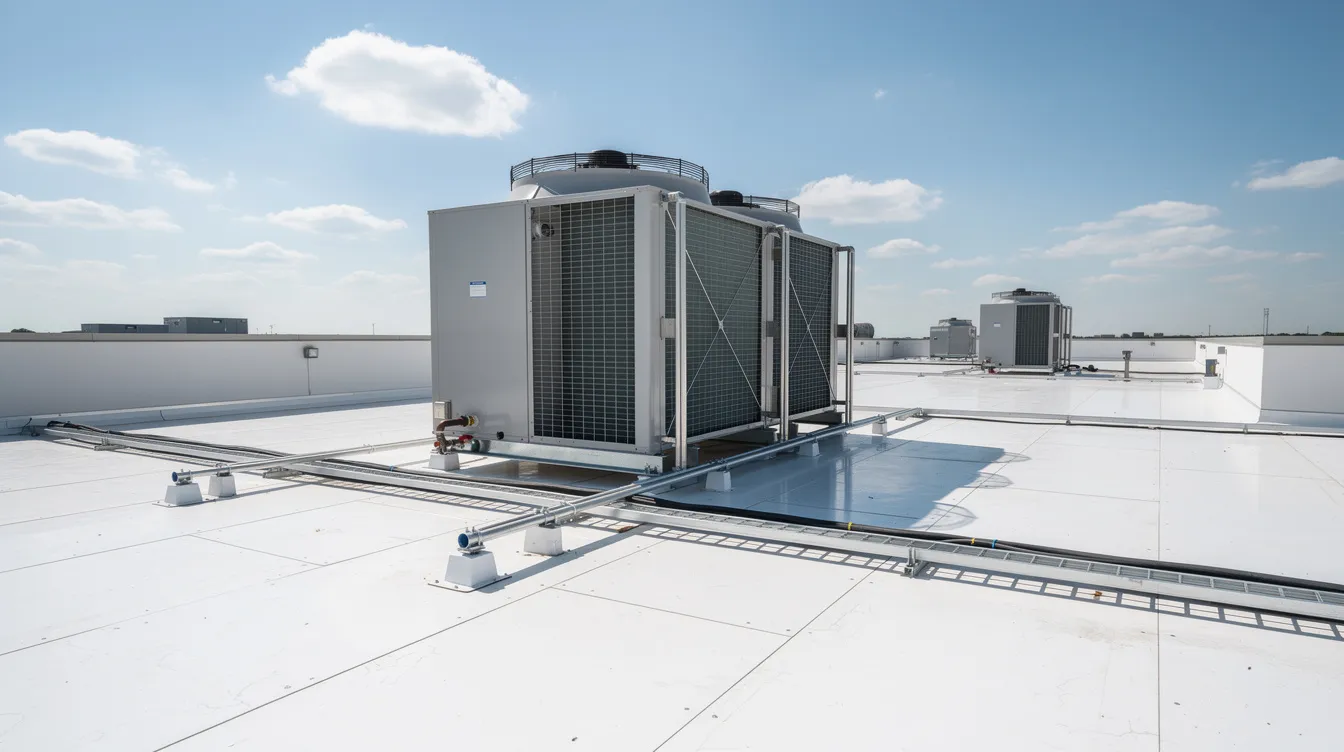
Air-cooled chillers reject heat directly to outdoor air through condenser coils and fans. They are commonly installed on rooftops of offices, retail centers, schools, and smaller industrial sites across New Orleans. Air-cooled chillers rely on fans for heat transfer, which means their performance depends heavily on outdoor conditions and coil cleanliness.
Key maintenance tasks for air-cooled units include:
Coil cleaning (both condenser and evaporator coils)
Fan motor and blade inspection; inspect motors for bearing wear and overheating
Checking refrigerant circuits, superheat, and subcooling
Verifying head pressure controls and high-pressure safety operation
Clearing airflow obstructions from vegetation, debris, or adjacent equipment
New Orleans heat and high humidity push head pressures higher on air-cooled units, requiring clean coils and proper fan operation to maintain efficient operation. Hurricane season debris - leaves, plastic sheeting, roofing material - can clog condenser coils and should be checked after every major storm.
Why Dirty Condenser Coils Hurt Air-Cooled Chiller Performance
Dirt, pollen, and biological growth insulate condenser fins, raising condensing temperature and increasing the compressor's power draw. The result: higher kW/ton, reduced cooling capacity, and the risk of high-pressure safety trips during peak summer months when cooling demand is highest.
Regular coil cleaning reduces thermal resistance and helps the HVAC system deliver peak performance during 95°F August afternoons. Best practices include using appropriate water pressure (not exceeding manufacturer limits), approved cleaning chemicals, and protecting electrical components from spray.
New Orleans Mechanical Pros typically recommends at least annual coil cleaning for air-cooled chillers, with more frequent service for coastal-exposed sites or facilities surrounded by heavy vegetation.
Water-Cooled Chiller Maintenance in New Orleans
Water-cooled chillers use condenser water loops and cooling towers to reject heat. They are the standard choice for large commercial buildings, hospitals, hotels, and industrial facilities around New Orleans because water-cooled chillers are more efficient than air-cooled chillers - typical full-load efficiency for water-cooled centrifugal units ranges from 0.45 to 0.65 kW/ton compared to 1.0 to 1.3 kW/ton for air-cooled systems.
Main maintenance areas for water-cooled systems include:
Condenser tubes and evaporator tubes
Cooling towers (basin, fill, drift eliminators, fans)
Condenser water and chilled water treatment
Pumps, strainers, and water inlets
Approach temperature monitoring
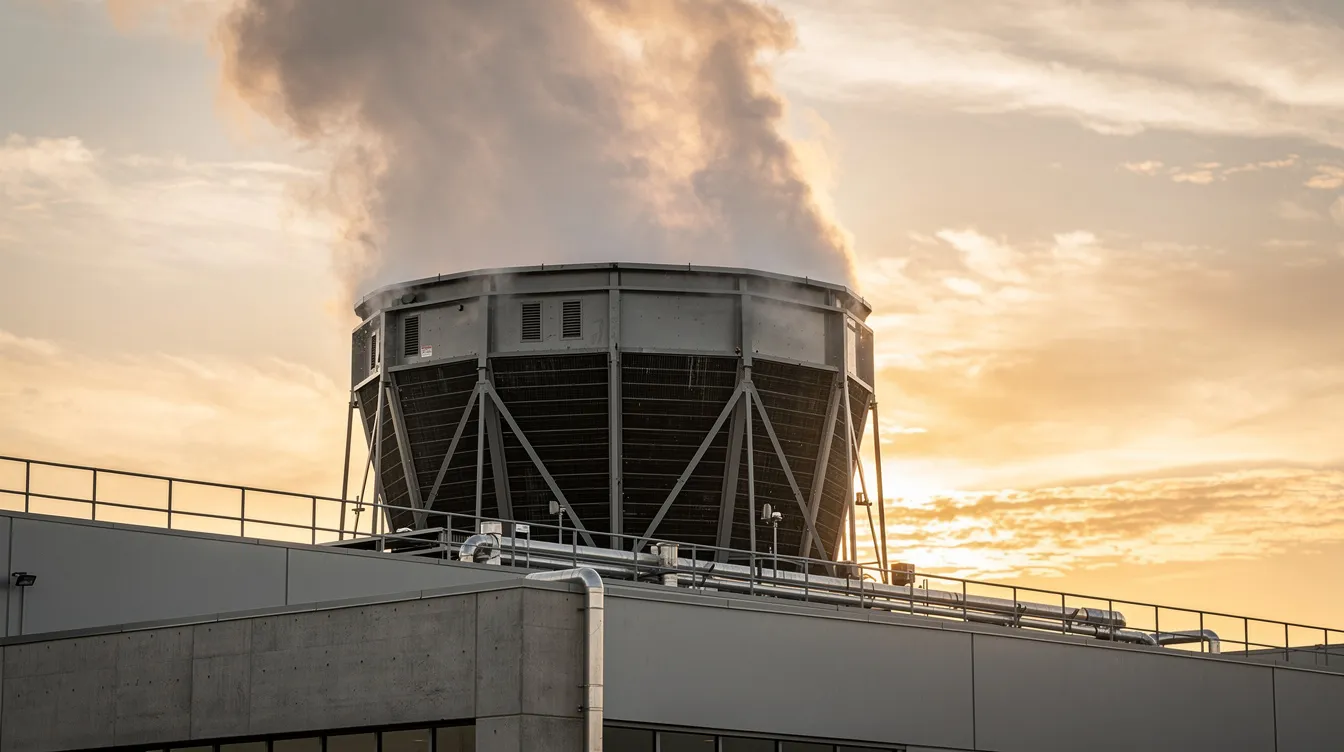
New Orleans' warm, humid environment accelerates scale and biological fouling in condenser water loops. Open-loop condenser water systems in humid areas are prone to rapid biological growth, and humidity accelerates biological contamination in these systems. Cooling towers require regular cleaning to prevent sludge and biological fouling.
New Orleans Mechanical Pros coordinates with water-treatment vendors to keep water chemistry within recommended ranges for scale, corrosion, and microbiological growth control.
Why Chiller Tube Cleaning and Water Treatment Matter
Mineral scale, corrosion products, and biological films significantly reduce heat transfer efficiency in condenser and evaporator tubes. Even a thin layer of scale increases thermal resistance, raises compressor discharge pressure, and drives up energy consumption. In one documented case at the Hilton New Orleans Airport, scale buildup reaching a fouling factor of approximately 0.003 on a 500-ton centrifugal chiller increased annual energy costs by $25,300.
Typical cleaning intervals are at least annual, with more frequent service for systems with poor water quality. Cleaning methods include mechanical brushing and chemical cleaning. A condenser approach temperature rising above 5 to 7°F is a reliable indicator of tube fouling in many commercial chillers.
Proper water treatment in condenser water and chilled water loops prevents scale, corrosion, and microbiological growth common in Gulf Coast climates. Weekly or bi-weekly monitoring for Legionella is essential in humid climates like New Orleans, where local code mandates documented water management plans. Good water treatment reduces long-term chiller maintenance costs and extends tube and shell life.
Signs Your Commercial Chiller Needs Maintenance Now
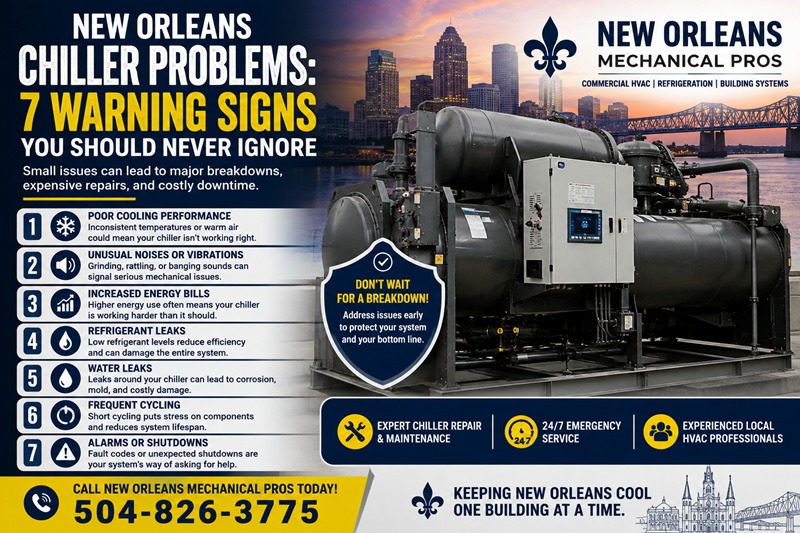
Many New Orleans businesses first notice symptoms rather than specific faults. Here are common warning signs and what they may indicate:
Chiller is not cooling properly - fouled tubes, low refrigerant charge, restricted water flow, or control issues
Energy consumption is increasing - degraded heat transfer, dirty coils, refrigerant problems, or poor part-load control
Short cycling - safety trips, sensor drift, low charge, or oversized equipment relative to current load
Unusual noises or vibration - bearing wear, loose components, liquid slugging, or compressor issues
Recurring high-pressure or low-pressure alarms - condenser fouling, water flow problems, or refrigerant issues
Chilled-water temperature too high - evaporator fouling, insufficient flow, or compressor capacity loss
Refrigerant leaks - oil stains near fittings, hissing sounds, or declining charge over time
Water leaks - failing seals, corroded piping, or cooling tower overflow
Frequent fault codes or unexpected shutdowns - control, sensor, or electrical failures
Do not bypass safeties or repeatedly reset alarms without diagnosis. Each alarm identifies a condition that requires investigation. Ignoring recurring alarms leads to larger, more expensive failures. For a deeper look at when a chiller problem requires immediate attention, see related content on New Orleans chiller repair warning signs.
How New Orleans Mechanical Pros Troubleshoots Chiller Problems
Troubleshooting is a structured diagnostic process, not trial-and-error part replacement. New Orleans Mechanical Pros technicians follow a systematic sequence:
Review operating history and recent maintenance records
Check active and historical fault codes
Measure entering and leaving water temperatures on both sides
Check refrigerant suction and discharge pressures
Verify chilled-water and condenser water flow rates
Inspect heat exchanger surfaces for fouling or damage
Evaluate compressor operation (amps, vibration, oil condition)
Inspect electrical components for damage, discoloration, or loose connections
Test sensors and controls against known reference values
Compare actual operation with design operating conditions and document findings
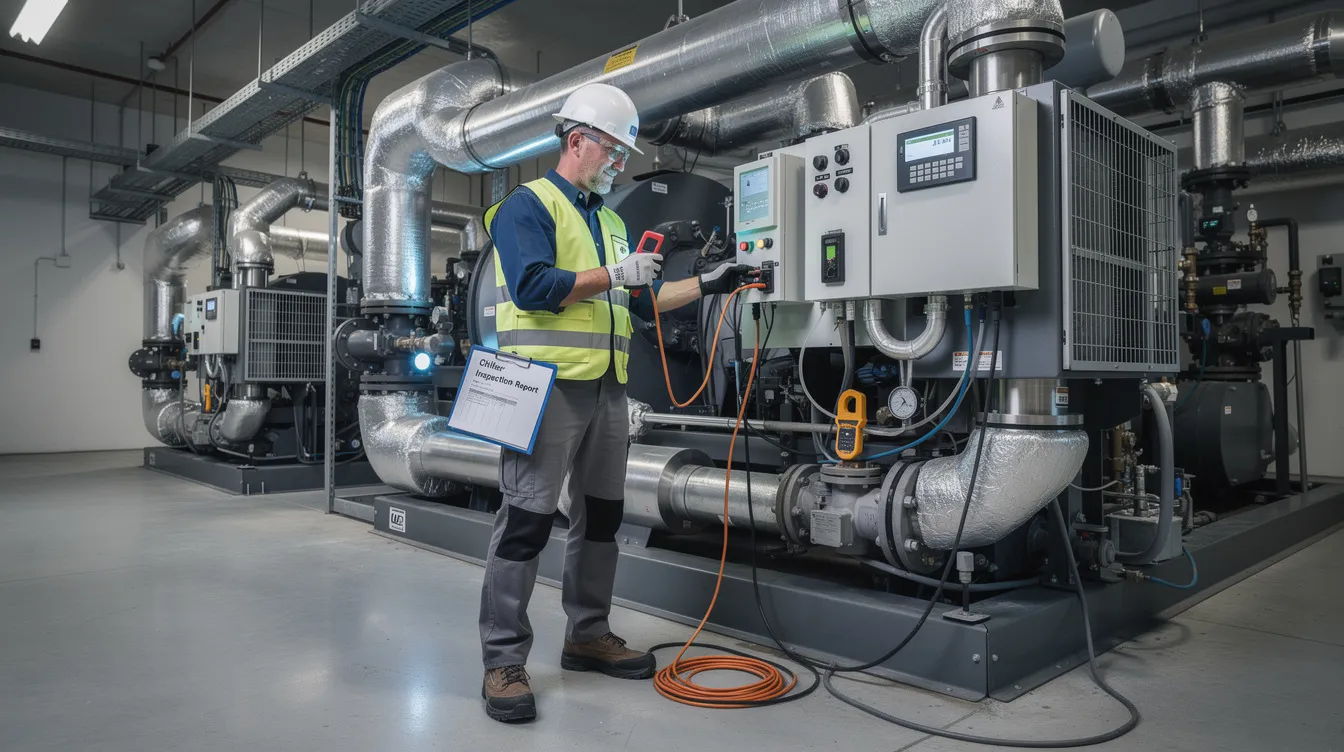
Technicians use digital gauges, infrared thermography, vibration meters, and BAS data to support diagnosis. Local factors - recent storms, changes in water treatment, nearby construction - are also considered when identifying root causes.
A fault code points to a condition (such as high pressure) but does not always identify the underlying reason. The cause could involve water flow restriction, condenser fouling, a failed fan motor, or a control logic error. Proper diagnosis prevents unnecessary parts replacement and reduces repeat service calls.
Chiller Efficiency, Heat Transfer, and kW/Ton
Chiller efficiency is measured as kW of electrical power consumed per ton of cooling produced (kW/ton). Lower numbers mean higher efficiency. For commercial facilities in New Orleans, where chillers run thousands of hours per year, even small improvements in kW/ton translate into measurable reductions in energy consumption.
Heat transfer in the condenser and evaporator directly governs system efficiency. Clean tubes, correct flow rates, and proper refrigerant charge keep the heat exchanger surfaces working near design capacity. Fouling, scale, or biological growth on tube surfaces increases thermal resistance, raises condenser pressure, and forces the compressor to work harder.
High chilled-water temperatures, elevated condenser water temperatures, or poor controls can all increase kW/ton. Modern variable frequency drives on compressors, pumps, and cooling tower fans improve part-load efficiency, which matters because most chillers spend the majority of their operating hours below full design load.
As a benchmark, the New Orleans Convention Center operates a 1,200-ton chiller at approximately 0.64 kW/ton over about 5,100 hours per year. New Orleans Mechanical Pros can benchmark existing chiller performance and propose maintenance or upgrades to reduce energy costs and achieve optimal chiller performance.
Chiller Maintenance Costs in New Orleans
This section explains cost drivers rather than quoting specific prices, because actual costs vary significantly by facility. The main variables affecting chiller maintenance cost include:
Chiller type: air-cooled, water-cooled, or absorption chillers
Capacity in tons
Equipment age and condition
Number of chillers in the plant
Maintenance scope (basic inspection vs. comprehensive service with tube cleaning)
Physical access (rooftop, basement mechanical room, elevated platform)
Water treatment requirements and complexity
Emergency repairs vs. scheduled maintenance
Industrial chiller systems, complex controls, and older HVAC equipment often require more labor, specialized diagnostics, and sometimes hard-to-source parts. Regular maintenance can decrease potential chiller maintenance costs over the life of the equipment by catching problems before they require major corrective work.
Planned preventive maintenance is usually less expensive over time than repeated emergency repairs and unplanned chiller downtime. Facility managers looking for customized solutions should request a maintenance proposal from New Orleans Mechanical Pros based on their specific plant configuration and operating requirements.
Chiller Maintenance vs. Repair vs. Replacement
Three distinct categories apply to commercial chiller service:
Chiller maintenance - planned inspection, cleaning, testing, adjustment, and monitoring to sustain peak efficiency and reliability
Chiller repair - corrective work performed after a component or system develops a fault or failure
Chiller replacement - installing new equipment when repair is no longer economical or the existing unit cannot meet current requirements
Situations that clearly require repair rather than routine maintenance include failed compressors, severe refrigerant leaks, damaged heat exchanger tubes, burned motor windings, or failed pumps. Evaluate equipment after flooding to assess contamination risks - flood-damaged controls, motors, and electrical panels often require immediate repair or replacement.
Decision factors for repair versus replacement include:
Chiller age (units beyond 20 years may not justify major investment)
Repair frequency and reliability history
Efficiency compared to modern equipment
Refrigerant type (phase-outs like R-22 affect long-term serviceability)
Major component condition (compressor, tubes, motors)
Repair cost relative to remaining useful life
With good maintenance, commercial chillers in New Orleans typically reach 15 to 18 years of service life, though this varies by equipment type, design, load, and environment. Poorly maintained rooftop units may only last 10 to 12 years. New Orleans Mechanical Pros provides lifecycle input to help owners decide whether to invest in a major repair or plan a capital replacement.
Commercial Chiller Brands and Systems Serviced
New Orleans Mechanical Pros services major commercial and industrial chiller brands, including:
Trane Chiller Maintenance
Trane centrifugal and helical-rotary chillers, including Tracer control platforms and proprietary diagnostics.
Carrier Chiller Maintenance
Carrier air-cooled and water-cooled chillers, including 19XR centrifugal and 30XA/30RB air-cooled product lines.
York Chiller Maintenance
York centrifugal and screw chillers, including YK, YVAA, and YLAA models with Microboard and Optiview controls.
Daikin Chiller Maintenance
Daikin air-cooled and water-cooled chiller systems, including Daikin Intelligent Equipment controls.
ASHRAE recommends adherence to manufacturer maintenance schedules for chillers. Technicians follow OEM procedures for tasks like tube cleaning, refrigerant handling, control updates, and safety testing. Familiarity with service bulletins and recommended intervals for these brands ensures consistent, reliable service.
New Orleans Facilities Served by New Orleans Mechanical Pros
Maintenance needs vary by facility type, operating hours, and cooling system design. New Orleans Mechanical Pros provides industrial chiller services and commercial chiller maintenance for:
Hotels and hospitality - guest comfort, ballrooms, kitchens, 24/7 cooling loads, redundancy during high-occupancy events like Mardi Gras and Jazz Fest
Hospitals and healthcare facilities - critical cooling for operating rooms, imaging labs, pharmacies, and infection-control zones; reliable service and redundancy are essential for sensitive equipment
Office and commercial buildings - comfort cooling, zoning, BAS integration, variable loads, and energy management for commercial clients
Schools and universities - seasonal loads, campus central plants, scheduling maintenance around academic calendars
Industrial and process facilities - process cooling, labs, industrial refrigeration, and continuous-operation requirements
Retail and mixed-use properties - changing cooling loads, multiple tenant systems, and air conditioning reliability
Data centers - 24/7 operation, tight temperature and humidity tolerances, minimal downtime requirements
Why New Orleans Businesses Choose New Orleans Mechanical Pros
New Orleans Mechanical Pros focuses on commercial HVAC and chiller systems. Core capabilities include:
Deep chiller diagnostics across centrifugal, screw, scroll, and absorption chiller platforms
Preventive maintenance programs tailored to New Orleans operating conditions
Rapid local response across the greater Orleans area for both scheduled maintenance and immediate response to emergencies
Experience with small commercial chillers and large central chilled-water plants, including condenser water loops, cooling towers, and complex controls
Coordination with building mechanical engineers, property managers, and contractors on maintenance windows, shutdowns, and capital projects
As a trusted provider of commercial HVAC maintenance in New Orleans, the company works with facility teams to reduce chiller downtime, improve chiller efficiency, and extend equipment life. Contact New Orleans Mechanical Pros for a site evaluation or maintenance proposal.
Commercial Chiller Maintenance FAQs
These questions address additional, practical concerns from New Orleans facility managers that are not fully covered in the sections above. Each answer begins with a concise response followed by brief clarification.
How should we prepare our chiller plant before hurricane season in New Orleans?
Verify roof and sump drainage near outdoor equipment. Secure air-cooled units against wind uplift. Back up all control settings and BAS programming. Confirm generator support for critical chillers. Remove loose debris around cooling towers. Schedule a pre-season inspection with New Orleans Mechanical Pros to confirm that all systems are in proper operation before the season begins.
What daily checks can our in-house team perform between professional maintenance visits?
Your in-house team should maintain a simple daily or weekly log: record entering and leaving chilled-water temperatures, check for active alarms, listen for unusual noises from compressors and pumps, visually inspect cooling towers and pumps for leaks or abnormal operation, and confirm that condenser water and chilled water flows appear normal. Daily logs help predict future damage to chiller systems and give your service technician valuable trending data.
Do absorption chillers in New Orleans need different maintenance than mechanical chillers?
Yes. Absorption chillers use heat instead of electricity for cooling, operating with a lithium bromide or ammonia solution pair. They require solution analysis for concentration and purity, purge system checks to remove non-condensables, heat-source inspections (steam traps or burners), and tight control of vacuum conditions. Standard water-side maintenance for evaporator and absorber tubes still applies. Chillers can be categorized into absorption, air-cooled, and water-cooled types, and each requires distinct maintenance expertise. New Orleans Mechanical Pros has technicians qualified to service absorption chiller systems.
Can we extend chiller life by upgrading controls or adding VFDs instead of replacing the unit?
In many cases, yes. Variable frequency drives on compressor motors, chilled-water pumps, and condenser-water pumps can substantially improve part-load efficiency and reduce mechanical stress. Control upgrades and improved condenser water management can extend useful life and support optimal operation when the core machine - compressor, heat exchangers, and shell - is still in good condition. New Orleans Mechanical Pros can evaluate whether a controls retrofit makes economic sense compared to full replacement.
What documentation should we keep from each chiller maintenance visit?
Maintain service reports that include the date, technician name, all readings (temperatures, pressures, kW, flow rates), alarms found, work performed, parts replaced, oil levels, refrigerant added or recovered, and follow-up recommendations. This documentation supports trend analysis, regulatory compliance, warranty claims, and long-term capital planning. Evaporative condensed chillers and other specialized systems may require additional documentation for water treatment and discharge records.
Schedule Commercial Chiller Maintenance With New Orleans Mechanical Pros
If your commercial chiller is losing cooling capacity, producing recurring alarms, consuming more energy, or simply due for preventive maintenance, contact New Orleans Mechanical Pros for commercial chiller maintenance in New Orleans. Whether you operate air-cooled chillers, water-cooled chillers, industrial chillers, or absorption chillers, the company provides services in New Orleans and across the Greater New Orleans area to keep your HVAC systems running at peak performance.
Schedule Commercial Chiller Maintenance - have your chiller inspected before a developing issue becomes an unexpected cooling failure.
Request Commercial Chiller Repair in New Orleans - if your system is already showing signs of trouble, reach out for prompt diagnosis and corrective service. Contact New Orleans Mechanical Pros at 504-826-3775
For additional guidance on when a chiller problem requires urgent attention, see our resource on New Orleans chiller repair warning signs you should never ignore.