
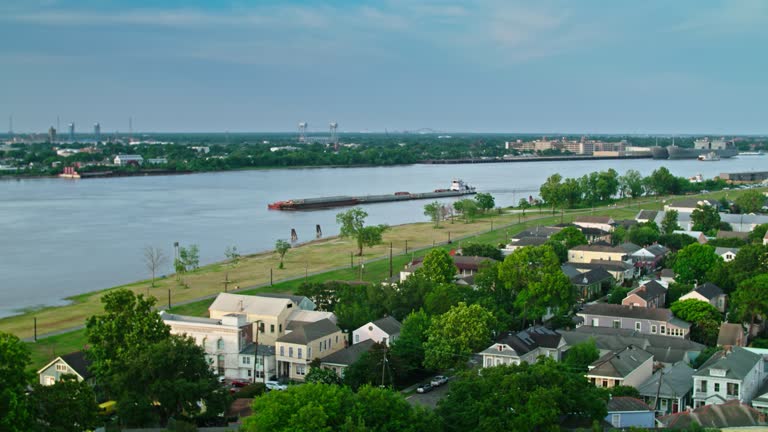
Why Greater New Orleans Demands Specialized AC Repair Expertise
Greater New Orleans sits at the intersection of subtropical heat, Gulf Coast humidity, and a built environment unlike anywhere else in the United States. Average summer temperatures regularly exceed 92°F, while the heat index — the "feels like" temperature that accounts for humidity — routinely climbs past 105°F from June through September. Relative humidity hovers between 70 and 85 percent throughout the cooling season. This combination creates mechanical stress on air conditioning systems that far exceeds what manufacturers design for in temperate climates.
The result is a city where AC repair is not a seasonal luxury — it is a year-round necessity. When an air conditioner fails in New Orleans in July, indoor temperatures can reach dangerous levels within hours. Children, elderly residents, and individuals with respiratory conditions face real health risks during extended outages. New Orleans Mechanical Pros was built specifically to serve this environment, with technicians trained on the unique failure modes that the Gulf Coast climate accelerates.
AC Repair Service Coverage Across Greater New Orleans
New Orleans Mechanical Pros provides air conditioning repair and air conditioner repair services across four parishes and 83 distinct neighborhoods. Service coverage spans from the historic districts of Orleans Parish to the suburban communities of Jefferson Parish, the industrial corridors of St. Bernard Parish, and the Northshore communities of St. Tammany Parish.
Orleans Parish AC Repair Service Areas
Orleans Parish encompasses the city of New Orleans proper, including its most densely populated and architecturally diverse neighborhoods. The housing stock ranges from pre-Civil War Creole cottages in the French Quarter and Tremé to Victorian doubles in Uptown and Mid-City, post-WWII ranch homes in Gentilly, and modern construction in the Warehouse District. Each housing type presents unique AC repair challenges — older homes often have undersized ductwork, inadequate insulation, and aging electrical panels that complicate system upgrades, while newer construction may use high-efficiency systems that require specialized diagnostic tools.
Key Orleans Parish service areas include Uptown, Garden District, French Quarter, Mid-City, Lakeview, Gentilly, Bywater, Marigny, Tremé, and Algiers.
Jefferson Parish AC Repair Service Areas
Jefferson Parish is the most populous parish in the New Orleans metro area, encompassing the suburban communities of Metairie, Kenner, Gretna, Harvey, Marrero, Terrytown, Westwego, and Belle Chasse. Jefferson Parish homes are predominantly post-1960s construction with central air conditioning systems, many of which are now approaching or exceeding their 15-to-20-year service life. Refrigerant transitions — from R-22 to R-410A and now to R-454B under EPA Section 608 regulations — have created a significant demand for system upgrades and retrofits throughout the parish.
Key Jefferson Parish service areas include Metairie, Kenner, Gretna, Harvey, Marrero, Terrytown, Westwego, and Belle Chasse.
St. Bernard Parish & Northshore AC Repair Service Areas
St. Bernard Parish — including Chalmette, Arabi, and Meraux — sits immediately east of Orleans Parish along the Mississippi River. The parish was heavily impacted by Hurricane Katrina in 2005, and much of its housing stock was rebuilt between 2006 and 2012. Post-Katrina construction often used higher-efficiency systems, but many of those systems are now 12 to 18 years old and entering a period of increased maintenance demand. The Northshore communities of Slidell, Mandeville, Covington, and Madisonville across Lake Pontchartrain round out the full service footprint.
The AC Repair Process: What to Expect
Step 1 — Diagnostic Assessment
Every AC repair service call begins with a comprehensive diagnostic assessment. Technicians use digital manifold gauges, refrigerant analyzers, thermal imaging cameras, and electrical multimeters to identify the root cause of the failure — not just the symptom. This prevents the common industry problem of replacing parts that are not actually faulty, which wastes money and leaves the underlying issue unresolved.
Step 2 — Upfront Written Estimate
Before any repair work begins, customers receive a written estimate with itemized labor and parts costs. New Orleans Mechanical Pros does not charge diagnostic fees that are then applied to inflated repair quotes. The estimate reflects the actual cost of the repair, with no hidden fees or surprise charges.
Step 3 — Repair Execution
Repairs are performed by NATE-certified technicians using OEM-specification parts wherever possible. Common AC repairs include capacitor and contactor replacement, refrigerant recharge and leak detection, evaporator and condenser coil cleaning, blower motor and fan blade replacement, drain line clearing, and thermostat calibration or replacement.
Step 4 — Post-Repair Verification
After every repair, technicians run a full system performance check — measuring supply and return air temperatures, static pressure, refrigerant subcooling and superheat, and electrical amperage draws — to confirm the system is operating within manufacturer specifications before leaving the property.
Common AC Problems Across Greater New Orleans
The Gulf Coast climate accelerates specific failure modes that are less common in drier or cooler regions. The most frequent AC repair calls across Greater New Orleans involve:
Refrigerant Leaks from Salt Air Corrosion
Homes within 10 miles of the Gulf of Mexico or Lake Pontchartrain are exposed to salt-laden air that accelerates corrosion on copper refrigerant lines and aluminum evaporator coils. Formicary corrosion — a pinhole leak pattern caused by the reaction between copper, moisture, and organic acids — is endemic in coastal Louisiana and requires specialized leak detection and coil replacement procedures.
Capacitor Failure from Voltage Fluctuations
Louisiana's aging electrical grid is subject to voltage fluctuations, particularly during peak summer demand periods. These fluctuations stress run capacitors and start capacitors in AC compressors and fan motors, causing premature failure. Capacitor replacement is one of the most common AC repairs performed across Greater New Orleans.
Drain Line Blockages from Humidity
With relative humidity consistently above 70 percent, condensate drain lines in New Orleans accumulate algae and mold growth faster than in any other major U.S. city. Blocked drain lines cause water overflow, ceiling damage, and mold growth in air handlers. Quarterly drain line maintenance is strongly recommended for all Greater New Orleans homeowners.
Frequently Asked Questions About AC Repair in Greater New Orleans
How quickly can you respond to an AC repair call in New Orleans?
New Orleans Mechanical Pros offers same-day AC repair service across all 83 service areas. For emergency calls — complete system failures, no cooling in extreme heat, or water damage from drain overflow — 24/7 emergency response is available. Call (504) 826-3775 for immediate dispatch.
Do you service all AC brands and models?
Yes. Technicians are trained and certified to service all major residential and commercial AC brands, including Carrier, Trane, Lennox, Rheem, Goodman, York, Daikin, Mitsubishi, and LG. Both central air conditioning systems and ductless mini-split systems are serviced across all Greater New Orleans service areas.
What is the average cost of AC repair in New Orleans?
AC repair costs in Greater New Orleans typically range from $150 for minor repairs (thermostat replacement, capacitor swap) to $650 for more complex work (refrigerant recharge, coil cleaning, motor replacement). Compressor replacement — the most expensive single repair — ranges from $1,200 to $2,500 depending on system size. New Orleans Mechanical Pros provides written estimates before any work begins.
Is it better to repair or replace my AC in New Orleans?
The industry standard guidance is the "5,000 rule": multiply the system's age (in years) by the estimated repair cost. If the result exceeds $5,000, replacement is typically more cost-effective than repair. In New Orleans, where systems work harder and age faster than in temperate climates, a 12-to-15-year-old system with a repair estimate above $400 is often a strong candidate for replacement rather than repair.